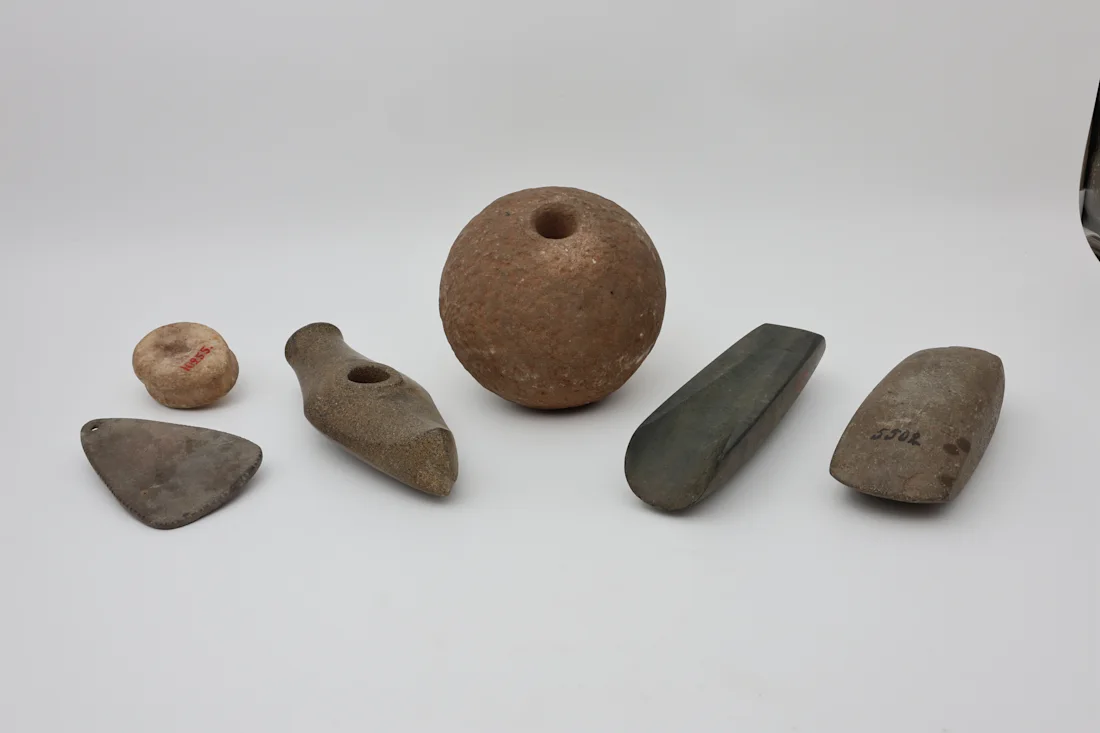
Satakunta goes 3D
The Finnish region of Satakunta has great prehistoric riches beneath the soil. Over the years, archaeologists have discovered an incredible number of objects, which are on display in the Satakunta Museum. But the time has come to move the found objects into a new era - the digital era.
A few years ago, the Satakunta Museum entered the era of 3D digitisation, expanding its capabilities to include high-resolution 3D scanning and photogrammetry. Since then, the museum’s collection has grown to include dozens of carefully digitised artifacts spanning several centuries. These digital surrogates not only support research and conservation work, but also open new possibilities for public engagement by making fragile and rare objects accessible beyond the physical exhibition space.
However, while the digitisation process itself has advanced significantly, the museum now faces the challenge of enhancing how these 3D materials are presented and used. Digital models should not remain static files in an archive; they should serve as dynamic tools for interpretation, learning, and interaction.
This is where Twin it! Part II, provides an ideal framework, encouraging institutions to rethink how digital heritage can be shared, experienced and contextualised. The campaign, a collaboration between the Europeana Initiative and the European Commission, invites Ministries of Culture of European Union Member States to collaborate with their national cultural institutions to submit at least one high-quality 3D-digitised heritage asset to the common European data space for cultural heritage with clear reuse intent. The archaeological collections from the Satakunta Museum were chosen for the submission from Finland.
To maximise the impact of the campaign, we established a collaboration with the University of Turku’s Department of Mechanical and Materials Engineering. The department contributes not only technical expertise but also access to advanced scanning equipment and 3D printing facilities. This partnership enables a seamless workflow and production of accurate physical replicas, which can be used for educational workshops and tactile accessibility initiatives.
Following initial discussions, the museum’s archeologists selected 20 artifacts from the Stone, Bronze, and Iron Ages that best represent the technological development of the Satakunta region. The selection includes stone and metal tools, weapons, amulets and wooden objects.
The 3D digitisation process
The selected items were transported to university laboratories in several carefully planned batches in order to ensure safe handling and optimal scanning conditions. In the university’s laboratories, they were scanned using high-precision 3D metrological scanners. The scans were then edited and the items sent back to the museum along with the digital files.
Because metrological scanners prioritise geometric accuracy over colour capture, the resulting models did not include any textural information. The museum’s digitisation specialist additionally generated surface textures using photo-based UV mapping. Calibrated photographic documentation was projected onto the scanned 3D meshes. This process restored the visual characteristics of the artifacts while preserving the geometry produced in the laboratory.
The volume of raw data was considerable, ranging between approximately 5-10 GB per object depending on size and complexity. After mesh decimation, UV mapping, texturing and compression, the final presentation-ready models were reduced to approximately 90-100 MB each. This optimisation balanced file size with visual fidelity, making the models suitable for online dissemination without compromising essential details.
SketchFab was chosen as the display platform due to its accessibility, stability and integrated 3D editor. The platform’s built-in tools improved the appearance of the final models in terms of glossiness, reflectivity and lighting parameters.
The optimised 3D models are published via SketchFab and integrated into both Finna.fi and Europeana.eu, making them available through the data space. This process will be carried out in cooperation with the National Library of Finland, which operates the Finna service and serves as a national aggregator for Europeana. Through this publication process, the digitised artifacts will become accessible to both national and international audiences.
Visions for 3D in the future
Once we have scanned and compiled all the selected items for Finna and Europeana.eu, we will organise workshops for schools. Our aim is to demonstrate that history and modern technological processes can complement each other in the field of education. At the same time, we aim to stimulate young people’s interest in history. It is crucial for future generations that history is preserved and developed in digital form through various interactive methods. This could take the form of 3D digitisation or computer games, for example. We find it important to demonstrate that history can evolve in modern society.
Find out more
We invite readers to explore the full project documentation and interactive 3D models on our project website, where they can engage with the digital reconstructions and gain insight into the research process. You can also find out more about Twin it! on the data space website.