The impact assessment of Europeana 2019 was our first in-depth look at one of our annual conferences, offering us a snapshot into life pre-COVID-19 and setting in place a baseline for assessing our first all-digital conference, Europeana 2020. How did the two events compare?
Building communities
‘Connect communities’ was the theme of Europeana 2019, and unsurprisingly, professional network growth was the strongest outcome for attendees and for 89% of those surveyed who had been to past conferences. We also measured network development, finding that participants at Europeana 2019 made a median average of seven new contacts, and anticipated that they may work in future with around three of these people. In comparison, this declined to three and one respectively for Europeana 2020 attendees. Network development was not a core objective of Europeana 2020, so this in itself isn’t surprising.
What Europeana 2020 helped to create - despite the online format and despite participants creating fewer new contacts - was a sense of community. 74% of participants felt like part of a community around digital cultural heritage - a 5% increase from 2019. Having had a tough year, we were thrilled to see that 86% of participants reported enjoying themselves as a top outcome of their participation.
Increasing accessibility and growing the Network
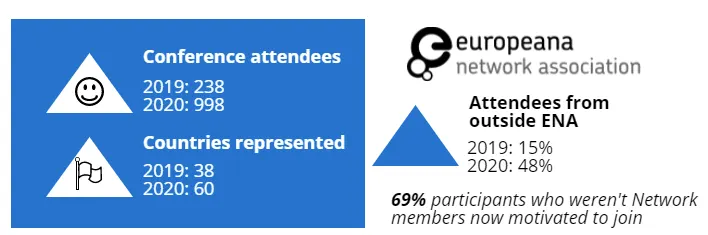
The digital format of Europeana 2020 meant that almost 1,000 people attended from 60 countries across the world, in comparison to 238 participants from 38 countries in 2019.
Some participants who attended Europeana 2020 might not have been able to attend had the conference not been digital, with travel, cost and limitations on attendance being potential barriers. The digital format was also more flexible because participants could pick and choose the parts of the event which were most relevant for them.
At Europeana 2019, we estimated that fewer than 15% of attendees were non-Network members. The increased accessibility of Europeana 2020 meant that this increased to 48% just one year later. Importantly, 69% of non-Network members agreed that the conference had motivated them to become members.
For the first time, and thanks to the recommendations of the New Professionals Task Force, we asked participants about how long they had been working in the sector. The data suggests that there is a roughly even split across participants in terms of their sector experience. We feel that, compared to past in-person conferences, the digital event is likely to have attracted an audience with less sector experience. We will track this at future in-person and digital events.
Building capacity and creating change
In impact assessment, we want to know about how participants might go on to create change as a result of an activity. In our 2019 impact assessment, we learned that 74% of attendees of past annual conferences shared information they had gained with others. We know that Europeana 2020 had value in some way for the vast majority of participants. But what did this look like and how did it change from 2019?
There was an increase in participants gaining skills or knowledge that they can use in practice. 88% of Europeana 2020 participants reported that the conference had value for them personally or professionally. They gained benefits such as new perspectives, empowerment and inspiration. There was also a significant increase in participants wanting to change how their organisation uses digital cultural heritage.
We don’t have a long-term perspective on what this change might look like. We also saw that where 63% of participants wanted to make changes to how their organisation uses digital cultural heritage, only around half of participants feel empowered to take action. This suggests that there is still work to do to match changing mindsets with the tools and agency needed to create change.
Better understanding environmental impact
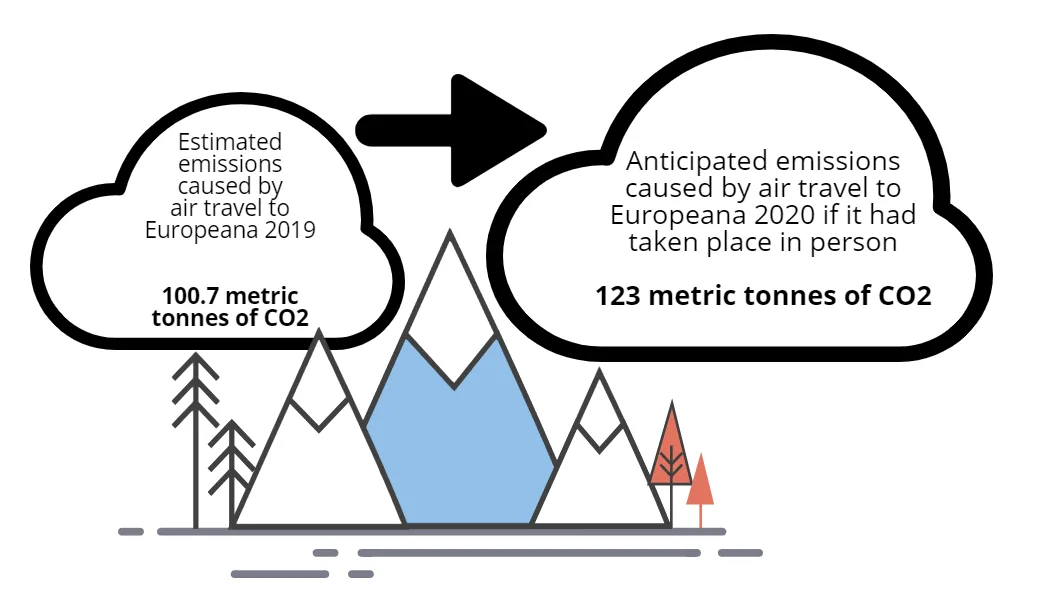
Holding Europeana 2020 digitally resulted in a significantly smaller carbon footprint. Europeana 2019 was held in Lisbon and over 90% of attendees were estimated to have travelled by air. If we had been able to hold Europeana 2020 in the Netherlands as planned, we estimate that the environmental impact of participants travelling by air to Europeana 2020 would have been 123 metric tonnes of carbon. Putting this in perspective, attending Europeana 2020 digitally was anywhere between 15 and 149 times less detrimental to the environment than the air travel alone that would have been required to attend the in-person event.
Looking to Europeana 2021
Learning from what you find in the data you collect is a key part of the iterative methodology outlined in the Europeana Impact Playbook. We’ll continue to use Playbook tools to help us plan Europeana 2021, which takes place from 10 - 12 November, and to design the impact assessment. Our Call for Proposals for Europeana 2021 is live - find out more and submit a proposal.
In the meantime, you can read the full Europeana 2019 impact assessment summary and full report and Europeana 2020 impact assessment summary and full report!