The European Heritage Hub: supporting Europe’s triple transformation
The European Heritage Hub is an EU-funded pilot project run by a consortium of 20 partners, led by Europa Nostra and including the Europeana Foundation. It aims to strengthen capacity, generate and share knowledge, and facilitate networking within Europe’s cultural heritage world. Its goal is to unlock the potential of the cultural heritage ecosystem to drive and inspire the ‘triple transformation’ of Europe, with its digital, green and social dimensions.
Focus on a responsible digital transition in cultural heritage
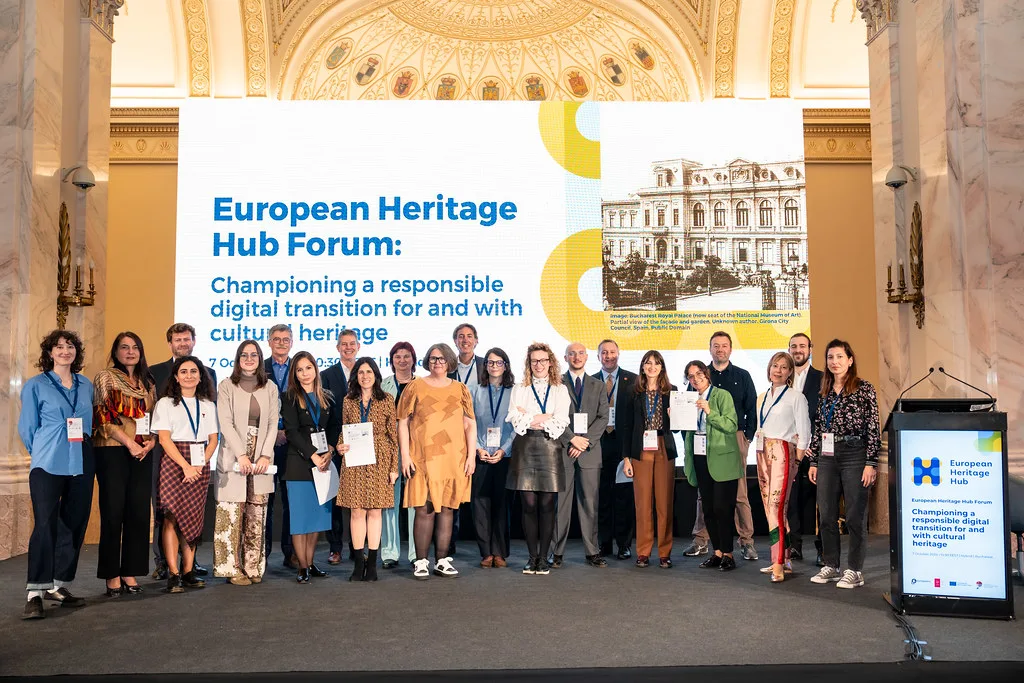
Building on the success of the inaugural European Heritage Hub Forum in Venice in 2023, the Hub's second Forum explored the themes of a socially and environmentally responsible digital transition for and with cultural heritage. It brought together over 400 attendees, both onsite and online, including heritage professionals, volunteers, policymakers at all levels and representatives from civil society. It was hosted at the historic Royal Palace (National Museum of Art), located in the heart of Bucharest, and online.
Organised by the Europeana Foundation and Europa Nostra in partnership with the European Heritage Hub project consortium, the Forum was a key highlight of the European Cultural Heritage Summit 2024 hosted by Europa Nostra under the High Patronage of the President of Romania and with the support of the European Commission.
The Forum featured two interconnected components. First, policy conversations brought together heritage experts, decision-makers and Hub stakeholders to assess the digital transformation of the sector, focusing on Artificial Intelligence and climate action. Second, an interactive fair showcased eight diverse projects that leverage digital technologies to promote sustainability, inclusion and diversity in the heritage sector, complementing discussions with hands-on action.
Opening, policy context and scene setting
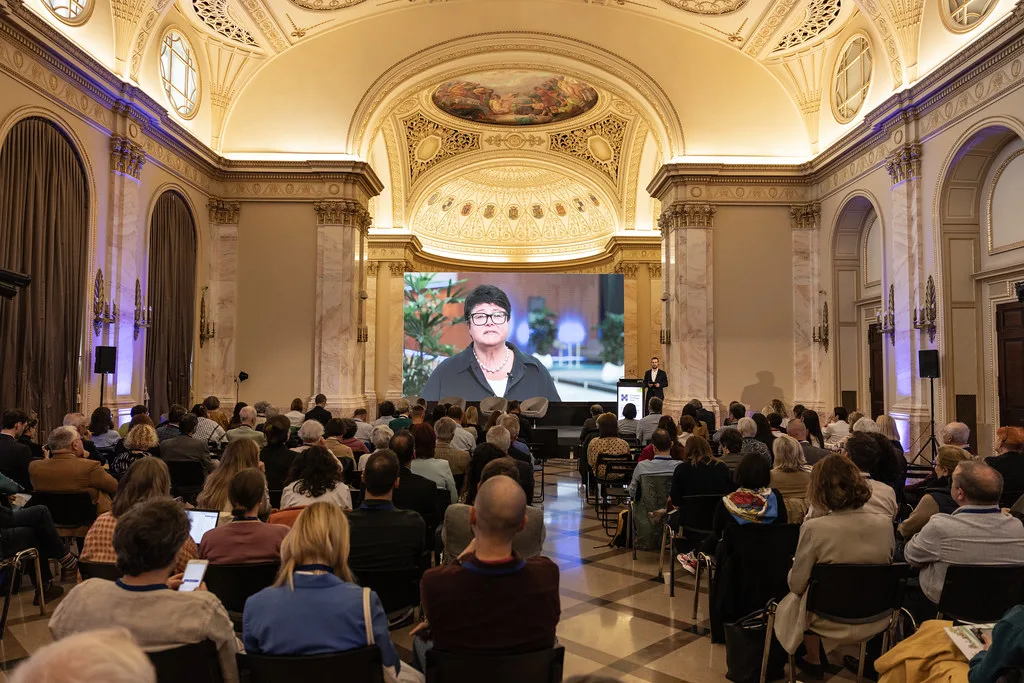
The Forum opened with a powerful video message from Sabine Verheyen, Vice-President of the European Parliament, who expressed her enthusiasm and support for the European Heritage Hub pilot project. She emphasised the importance of the Forum discussions and outcomes in ‘shaping Europe’s digital future, where heritage plays a crucial role’.
Following her address, Oana Zaharia, Manager of the National Institute of Heritage, spoke on behalf of the Romanian Ministry of Culture. She outlined the Institute's efforts and ambitions in digital transformation, highlighting its role as the proud national aggregator for Europeana in Romania.
In his remarks on behalf of the European Heritage Hub, Harry Verwayen, General Director of the Europeana Foundation, emphasised the strong connection between the digital transition of the heritage ecosystem and its social and environmental responsibilities. He positioned digital cultural heritage as a key contributor to Europe’s triple transition which will demand, above all, a true cultural shift.
Highlighting AI in cultural heritage
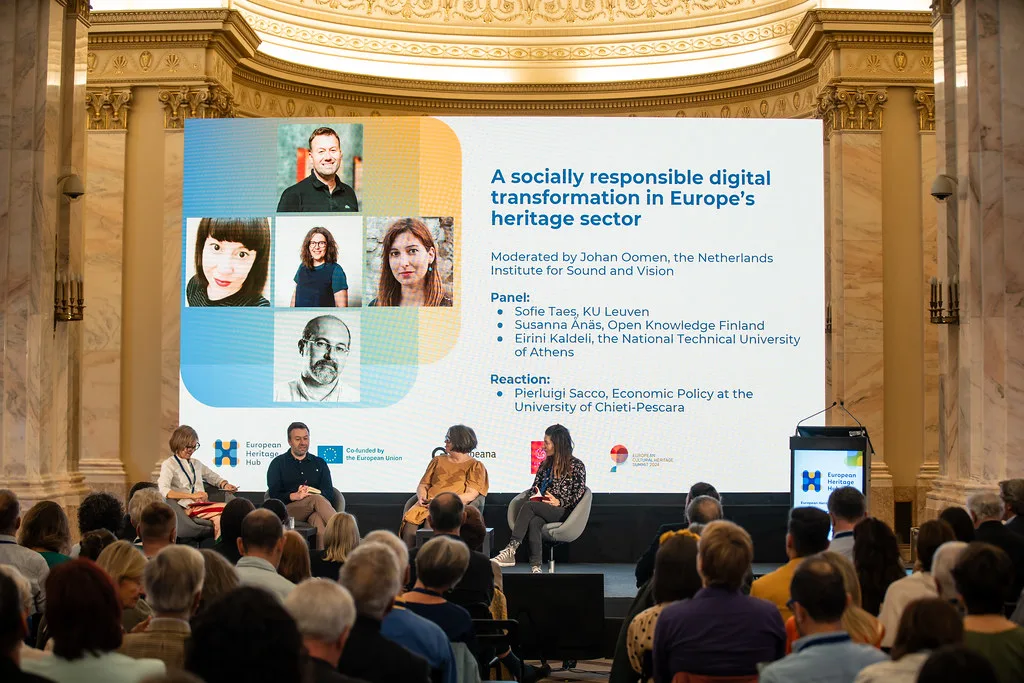
The first panel conversation focused on the responsible use of AI in our sector, featuring insights from Oonagh Murphy, Senior Lecturer at Goldsmiths, University of London, and a video provocation by Paul Keller, Co-Founder of Open Future.
Panellists included Sofie Taes, Innovation Manager at KU Leuven; Susanna Ånäs, Interim Executive Director at Open Knowledge Finland; and Eirini Kaldeli, Senior Researcher at the National Technical University of Athens, moderated by Johan Oomen from the Netherlands Institute for Sound and Vision. Pierluigi Sacco, Professor of Economic Policy at the University of Chieti-Pescara, delivered the concluding remarks.
Contributors emphasised that AI - much like cultural heritage - should be viewed as a public good, requiring ethical frameworks for its use. The potential of the creative and cultural sectors to provide a platform for critical technology discourse was also highlighted. Contributors called for greater support for cultural heritage professionals to engage critically with AI use and development. Notably, the current market offerings lag behind the advanced solutions being tested by big tech. To help the cultural heritage sector catch up, it is essential to secure funding, develop use cases, share insights, and encourage policymakers to invest in best practices for AI.
Exploring heritage and climate action
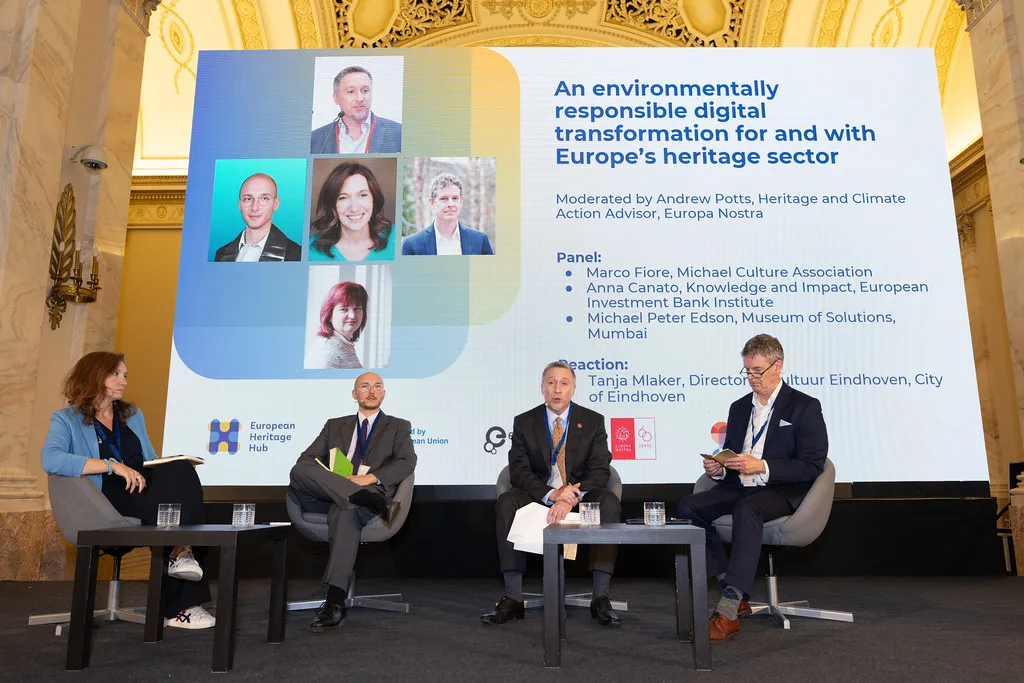
The second panel conversation focused on an environmentally responsible digital transition in cultural heritage. Insights were shared by Michelle Thorne, Director for Strategy and Partnerships at the Green Web Foundation, along with a provocation from Michael Peter Edson, founding director of the Museum of Solutions.
Moderated by Andrew Potts, Heritage and Climate Action Advisor at Europa Nostra, the panel included contributions from Marco Fiore, Policy Manager at the Michael Culture Association; Anna Canato, Head of Division, Knowledge and Impact at the European Investment Bank Institute; and Michael Peter Edson. Tanja Mlaker, Director for culture at the City of Eindhoven, provided the concluding remarks.
Contributors advocated for transparency regarding the environmental costs of technology, and for developing digital infrastructures that serve the public good and operate within planetary boundaries. They emphasised the need for strengthening democratic participation in decision-making about digital infrastructures and strategies. Thoughtful and informed choices, which often involve trade-offs, were also highlighted as essential.
Networking and best practices: the interactive Fair
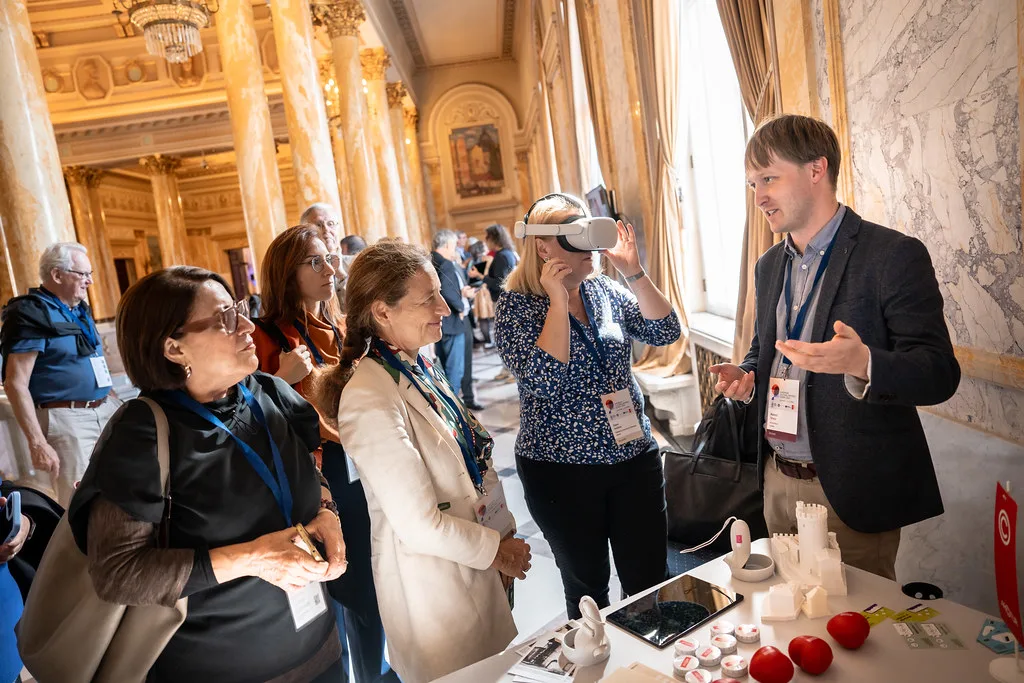
The Interactive Fair showcased projects at the intersection of digital heritage and social and green transformations, from AI platforms for cultural heritage to 3D and XR applications that promote sustainable tourism and accessibility for visually impaired audiences. The Fair highlighted eight projects: AI4Culture, ARCTUR, DE-BIAS, The Hunt Museum, MuseIT, Tijdlab, 5D Culture and EUreka3D.
During the Fair, participants had the opportunity to engage with hands-on digital technology, network and exchange ideas in an inspiring and interactive setting.
Discover the European Heritage Hub Call to Action
During the concluding session of the Forum, Harry Verwayen, General Director of the Europeana Foundation, and Graham Bell, Board Member of Europa Nostra, presented the European Heritage Hub Call to Action, titled Championing a responsible digital transition for and with cultural heritage.
Collaboratively prepared by the European Heritage Hub partners, with the Europeana Foundation and Europa Nostra leading the effort, the Call to Action builds on the Forum discussions and incorporates input from contributors. As a tangible outcome of the Forum, it serves as an advocacy tool to convey key messages to policymakers at all levels of governance, outlining five priorities to advance a holistic digital transformation in cultural heritage.
Prof. Dr. Hermann Parzinger, Executive President of Europa Nostra, and Bailie Annette Christie, Glasgow City Convener for Culture, Sport, and International Relations, responded to the Call to Action, highlighting its strategic value in guiding the Hub’s work. They urged policymakers to subscribe to the Call and support its strategic priorities - from securing funding for the sector’s digital transformation, to advancing research and skills development, developing sector-specific AI guidelines and harnessing digital heritage to promote environmentally responsible practices.
Read the Call to Action and share it widely! We hope you find it useful and inspiring for your own work.