Introduction of IIIF manifests for 3D
The development and recent release of the first draft IIIF Presentation API manifests encoding 3D content mark a critical milestone to complement and extend existing IIIF specifications. These manifests and the corresponding specifications have been developed by the 3D Technical Specification Group (TSG) to consider the complexity of 3D objects, addressing issues such as spatial orientation, lighting and camera settings. This is crucial for the digital preservation and presentation of cultural heritage.
The goal of the manifests is to create a standard for seamless integration and interaction with 3D content across different platforms and institutions. The available manifests are being constantly expanded and currently include ways to:
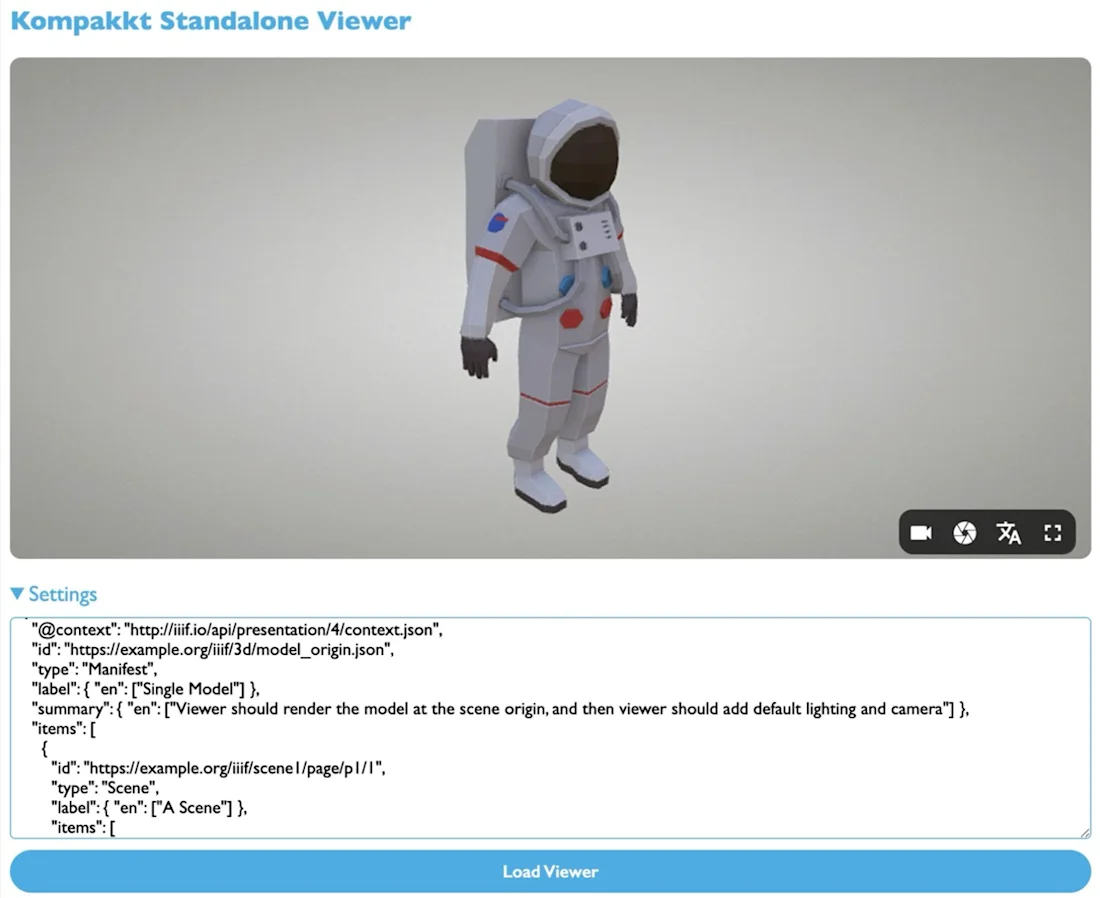
place a basic model in a scene
include and exclude model features such as specific lighting or camera settings
add two canvases in a scene
place several objects in a scene
Implementation and examples from (Semantic) Kompakkt
Now that the drafts are available, the practical implementations can be realised. Several viewers (i.e. software tools for viewing 3D media) have piloted the implementation of the API and can process the manifests.
One of those viewers is Kompakkt, which an interdisciplinary team at several German universities, research institutions and libraries has been developing since 2017. It is a free online repository and (3D) viewer for multi-modal 3D annotations, specifically designed for collaborative work and storytelling. Kompakkt is fully open source and optimised to provide public access to cultural heritage objects, archival material or similar. It enables users to share, explore, and collaboratively annotate objects in standard modern web browsers. It is based on Babylon.js, Angular and MongoDB.
In addition, a semantic extension, Semantic Kompakkt, was developed at Open Science Lab, TIB Hannover, as part of the project NFDI4Culture. It utilises a database connection to Wikibase, the open source, linked open data environment released by Wikimedia Germany to allow users to add semantic data and annotations to multimedia content. (Semantic) Kompakkt is now able to interpret the IIIF draft manifests and load 3D objects accordingly (see the code and work-in-progress deployment). While the basic functionalities offered by the manifests are covered by (Semantic) Kompakkt, additional features can be explored. The development will consider the needs of its users including, for example, the placement of several individual 3D objects in a scene or the combination of different media content such as images and 3D models.
Presentation at the IIIF Annual Conference in Los Angeles
The recent IIIF Annual Conference in Los Angeles provided a platform to present the progress of the TSG to a global audience. The Group highlighted critical differences to 2D content and presented solutions and results. In addition, a lightning talk showed how (Semanic) Kompakkt implements the API to showcase manifest use for viewer software.
A so-called Birds of a Feather session brought interested parties together to see demos and dive deeper into the technical details. Participants discussed their experiences, challenges, and wishes regarding 3D integration in this session.
A concluding meeting with the TSG explored further specifications and brought agreement on the next steps and milestones, which can be consulted in the IIIF 3D Technical Specification Group Charter.
The first version of the 3D manifests is expected to be released next year. In Los Angeles, TSG members also discussed additional features to be incorporated into the manifests, and in the upcoming Group meetings this year, they will address annotation, interactions and animation.

Technical insights
When implementing APIs to support data exchange standards, customised solutions in the existing code that worked only for a specific software setup become obvious and problematic. As soon as data is exchanged and processed across software applications, the processing steps must also be made more standardised and reusable in the same way as the data formatting. This became especially noticeable during the implementation of the Babylon.js-based API for the IIIF manifests within (Semantic) Kompakkt.
For example, it was necessary to understand exactly how the space and coordinate system works. The way objects are placed in space must be coherent and replicable with other viewers if Kompakkt wants to be standard-compliant. The Kompakkt development team has to be able to account for new features that might need to be implemented because of the expanded possibilities of interoperability. This includes displaying multiple objects within the same scene. For more details, please observe our current development in our open GitHub and Gitlab repositories for Semantic Kompakkt and Kompakkt respectively.
Broader implications for digital collections
The adoption of IIIF 3D manifests has broader implications for the management and dissemination of digital collections. By standardising the way 3D content is described and accessed, institutions can ensure greater interoperability and longevity of their digital assets. This standardisation also facilitates collaboration between institutions, enabling shared access to 3D resources and collaborative research projects.
Get involved
The release and implementation of the first IIIF manifests for 3D represents a significant step forward in the field of cultural heritage with significant impact on research, especially in digital humanities. The work done by (Semantic) Kompakkt and others demonstrates the practical applications and benefits of these new standards. As the IIIF community continues to innovate and expand the capabilities of 3D interoperability, the future of digital collections looks increasingly multidimensional and interactive.
Are you interested in 3D interoperability? Here is how to get involved:
Join the IIIF community to learn more and consult with other community members if you need help with your digitisation workflow.
Participate in technical group meetings and test implementations.
Report issues or use case feedback related to IIIF on GitHub.
Publish your data on one or more online tools and repositories, and consider whether to use a commercial or open-source environment.
Join the EuropeanaTech community and the IIIF & Europeana Working Group to discuss IIIF and other topics related to research and development in the cultural heritage sector
Help shape the next phase of sharing multi-dimensional cultural heritage on the web!