On July 25 2025, the EC published a call for tenders to review the 2019 CDSM Directive . The study has been awarded to three companies , and it will gather qualitative and quantitative evidence on how the Directive’s provisions are performing in practice. This may be followed by updates to the Directive based on the evidence gathered.
For the Europeana Initiative, the OOCW provisions in the 2019 CDSM Directive are crucial to the dissemination of cultural heritage. The system was designed to address the 20th century black hole, which the Orphan Works Directive did not solve .
Through this post, we take a critical look at what the OOCW provisions are doing in practice in the cultural heritage sector, on the basis of input gathered through our network.
The 20th century black hole
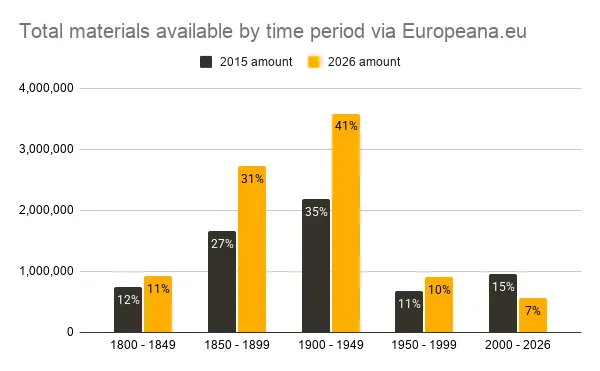
Back in 2015, Europeana Foundation published a report that demonstrated the existence of the 20th century black hole in its collections. As the report found, ‘Collections that consist of works dating from the 20th century or that contain large proportions of works from that period are available online to a much lesser degree than collections from the periods before or after the 20th century’. On that basis, it recommended that ‘in order to promote the online availability of cultural heritage from the 20th century, it is necessary to reduce the burden of rights clearance for these institutions’.
A bit more than ten years later, we have conducted an analysis based on the same queries. The results show that while there has been an increase of data, the distribution of this data broadly follows the same pattern as in 2015. Materials from the second half of the 20th century (1950-1999) continue to have a particularly low representation (10.43%) within the whole Europeana.eu dataset.
Total of out-of-commerce works declared
Since the adoption of the Directive in 2019 and its transposition (from 2021 to 2023, depending on the country), 2.7 million works have been registered in the EUIPO Out-of-Commerce Works Portal . That is, 2.7 million out-of-commerce works can be made available online under the coverage of the OOCW system. While it might seem like a fairly important number, it is far from being sufficient, when considering how many out-of-commerce works are housed in libraries, archives and museums across the EU.
Diving into more detail, the numbers also show that only certain countries, and certain institutions within those countries, are successfully using the provisions - and that they are a small representation of all of the organisations that could potentially benefit from the system. Some 92% of all registered works are concentrated in just three Member States: Slovakia (40.1%), the Netherlands (27.2%), and Czechia (24.9%). Growth has notably slowed, with only 200,000 works added in the last six months. Furthermore, only 16 Member States have registered at least one work in the registry to date, and 11 have no registration at all. Despite concerns regarding rights-holder control, the data shows that only 394 rights holders have opted out of these available works - a rate of just one opt-out for every 7,500 registered works. Looking at the public information on license fees, the licenses for the works in the three leading countries cost roughly 1.2 million euros in public sector funding per year.
Why are more out-of-commerce works not being declared?
For a while, some of us believed that the system was having a slow take-off because of the institutional workflows that had to be set up, the understanding that had to be built around the system, and the need for the sector to regain trust in this type of solution after having tried and failed in using the Orphan Works system.
Now it has become clear that the system is paralysed in most countries, and for most institutions. From conversations with colleagues who have looked into this across countries, the reasons vary. Let’s look at what those are:
1. Bottlenecks in licence negotiations
The system currently establishes that if there is a sufficiently representative collective management organisation (CMO) of the type of material in question, the exception does not apply, regardless of whether the licence is successfully concluded or not.
However, some negotiations have led to a dead end because of little interest from CMOs who do not have anything to lose by not granting a license, and little to gain by granting it.
In many cases, granting the license has not been officially refused, but bringing forward conditions that are impracticable by a cultural heritage organisation essentially leads to the same result. For example, some negotiations have taken up to four years, which is something that only large cultural heritage organisations can afford to undertake. The system is meant to support the dissemination of out-of-commerce works across institutions and countries, not those of national libraries and national archives alone.
Historians, museum curators and librarians who embark on the digitisation of out-of-commerce works understand the materials, and the value they bring to society. The fact that some out-of-commerce works cannot be disseminated because a CMO that does not represent most or any of the works in question decides it to be so, feels very discouraging and alienating to these types of professionals, and takes away their trust in EU legal solutions.
2. Legal uncertainty around representativity
Many works have multiple layers of copyright and related rights. Audiovisual works and musical works are the most well-known examples in rights clearance complexity, but even a monograph has multiple copyright-protected contributions, such as text, images contained in it, the edition and cover design, etc.
These rights are managed separately by different CMOs, which means that a cultural heritage organisation might need to negotiate with two, three or more CMOs for a single work or collection. If these organisations are not able to come together in the negotiation, this also means that the cultural heritage organisation will have to pay multiple fees, and manage different conditions for the same type of materials.
Sometimes, being able to know whether a CMO is sufficiently representative is difficult. For example, in the Netherlands, cultural heritage organisations dealing with audiovisual materials are faced with the following question: does the legal presumption of a transfer of rights from the various authors to the producer of a cinematographic work mean that only the CMOs of the producers should be approached when seeking a license for out-of-commerce works?
3. Failed stakeholder dialogues
For many countries, extended collective licensing or presumptions of representation are a new system. For most cultural heritage organisations, obtaining licenses from CMOs is also completely new. When a cultural heritage organisation is left alone to approach a CMO (by rightly identifying one which is ‘sufficiently representative’ in the specific case), and to negotiate a license, there is an immediate deterrent effect. This is particularly the case if the CMO is not publishing upfront a licensing offer for out-of-commerce works.
In view of this, we strongly welcomed the obligation set out in the 2019 CDSM Directive for Member States to set up stakeholder dialogues on out-of-commerce works, in the following words: 'Member States shall consult rightholders, collective management organisations and cultural heritage institutions in each sector before establishing specific requirements (...) and shall encourage regular dialogue (...), on a sector-specific basis, to foster the relevance and usability of the licensing mechanisms (...)'. However, they have not happened in most Member States, and the parties are left alone to agree on various conditions.
Our recommendations
We recommend that the Directive be modified to establish that sufficiently representative CMOs are obliged to offer suitable licences covering the needs and specificities of cultural heritage organisations, and that these are made easily available on the market, for all of the types of materials for which they are representative. These should be made transparent to the public.
Failing to do that, cultural heritage organisations should be able to rely on the exception for out-of-commerce works.
There are many benefits to such an approach:
- The fact that the exception would apply would make CMOs more proactive in offering a licence. If on the contrary a CMO did not see a market opportunity in facilitating such licenses, the dissemination of cultural heritage would not suffer from it as the cultural heritage organisation would be able to disseminate out-of-commerce works under an exception.
- Cultural heritage organisations would probably conclude more licences, not fewer. They would be much more comfortable approaching a CMO given the transparent conditions, and would not have to undertake lengthy negotiation processes.
- Cultural heritage organisations would be able to operate according to their processes and organisational objectives, because more adequate conditions would be in place.
- Cultural heritage organisations would know when the exception applies, by having more clarity to the representative of the CMO thanks to the license offered.
The obligation to publish licensing conditions upfront is not new in EU lawmaking. Article 5 of the 2019 CDSM Directive on the ‘use of works and other subject matter in digital and cross-border teaching activities’ already establishes the obligation to offer suitable licenses if the exception or limitation to copyright does not apply.
In addition to that, we would welcome a clarification of what fair conditions fall under ‘suitable licenses’, which should include: a reasonable fee adapted to the public sector, no subsequent payments for works that have been paid for once, and the possibility of disseminating the works outside of the Member State (except when the CMO can only offer a license for the Member State).
These changes would substantially increase the ability of cultural heritage organisations to digitise and make available works that are no longer in commerce but hold great social, political and cultural value - progressively reducing the 20th century black hole.
Learn more
You can read more about this topic on the data space website . We will be sharing more updates via the Europeana Copyright Community communication channels.