A leading Wikimedia event in Spain
Wikimedia España is the official Spanish chapter of the global Wikimedia movement, supporting free knowledge projects like Wikidata as a collaborative, multilingual platform that provides structured data used across Wikimedia projects such as Wikipedia, becoming increasingly popular in the GLAM sector.
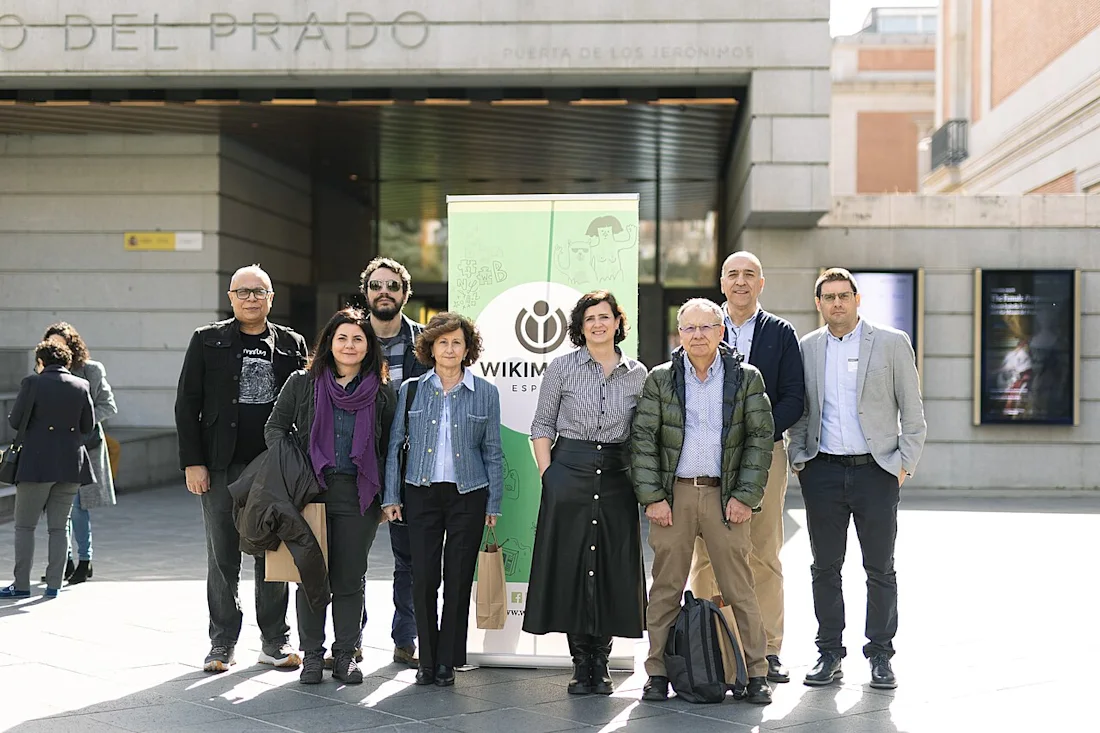
The second edition of their event ‘Patrimonio Conectado: Wikidata en el Ecosistema GLAM’ (‘Connected Heritage: Wikidata in the GLAM Ecosystem’) was held at the Museo Nacional del Prado in Madrid on 25 February 2026, bringing together professionals from museums, libraries, archives, universities and the Wikimedia community to reflect on a shared challenge: how to better connect cultural heritage through open data? The event highlighted that Wikidata is not merely a database, but a living ecosystem that connects collections and people.
The opening remarks were delivered by Alfonso Palacio, Deputy Director for Conservation at the Museo Nacional del Prado, who stressed the national and international reach of partnerships with Wikimedia.
Following his speech, six speakers introduced initiatives and projects related to data publication, reuse and impact developed at groundbreaking national cultural heritage and research institutions - the Prado Museum itself, Biblioteca Nacional de España , Biblioteca de la Agencia Española de Cooperación Internacional para el Desarrollo (AECID) and Universidad de Salamanca . All of these institutions have made use of Wikidata for different purposes, such as enrichment, visualisation and assessing data quality.
The international dimension
The event also aimed to connect Spanish experimentations in digital cultural heritage with a wider European context by inviting representatives from the International GLAM Labs Community (which supports access to digital collections and data to experiment with in spaces such as Labs) and the Europeana Initiative, as the steward of the common European data space for cultural heritage.
The event gave us the opportunity to highlight how closely connected Spain is to the Europeana Initiative - three Europeana Aggregators are based there (Hispana, Catalonica and Euskariana), while the nearly 6,340,000 digital items on Europeana.eu provided by Spain place it among the top three EU countries that contribute data to the common European data space for cultural heritage via the platform. Spanish was the language used for the pilot that paved the way to multilingual search on Europeana.eu. More recently, the Prado Museum contributed a dataset of 124 items to Europeana.eu, representing a significant sample of the masterpieces of its collections. A few days after the event, a large dataset of textual resources (in total 15,377 items) from the Biblioteca Digital del Museo del Prado was integrated into Europeana.eu.
Looking ahead
As an event surveying the landscape of the use of Wikidata within cultural heritage and research institutions in Spain, what did it tell us about the future potential of the connections between these institutions and Wikimedia, also in a European context?
The represented institutions are in an excellent position to adopt new open trends focused on data publication and reuse. While all the institutions have adopted Wikidata for different purposes and goals, new tools such as Wikibase facilitate the publication of machine-readable metadata. Recent initiatives are focused on the integration of Wikibase in GLAM institutions. Wikibase could be the potential next step, even if training is required for the staff in institutions in order to start adopting it.
The institutions that host rich digital collections could also make an excellent contribution to data infrastructures, in an international setting characterised by initiatives such as the common European data space for cultural heritage, and the European Collaborative Cloud for Cultural Heritage (ECCCH). It may be worth exploring how Wikidata and the Wikimedia community could exchange and collaborate with the communities aggregated by these major European initiatives in cultural heritage, as Europeana is an active user of Wikidata and, in the past, it explored how to strengthen relationships with Wikimedia, which resulted in several joint initiatives.
Find out more and get involved
You can find the summary of the presentations given at the Wikimedia event at the Prado Museum on the Wikimedia website .
If you are a Wikimedian based in Europe and foresee potential collaboration with the Europeana Initiative and the common European data space for cultural heritage, please get in touch with [email protected].