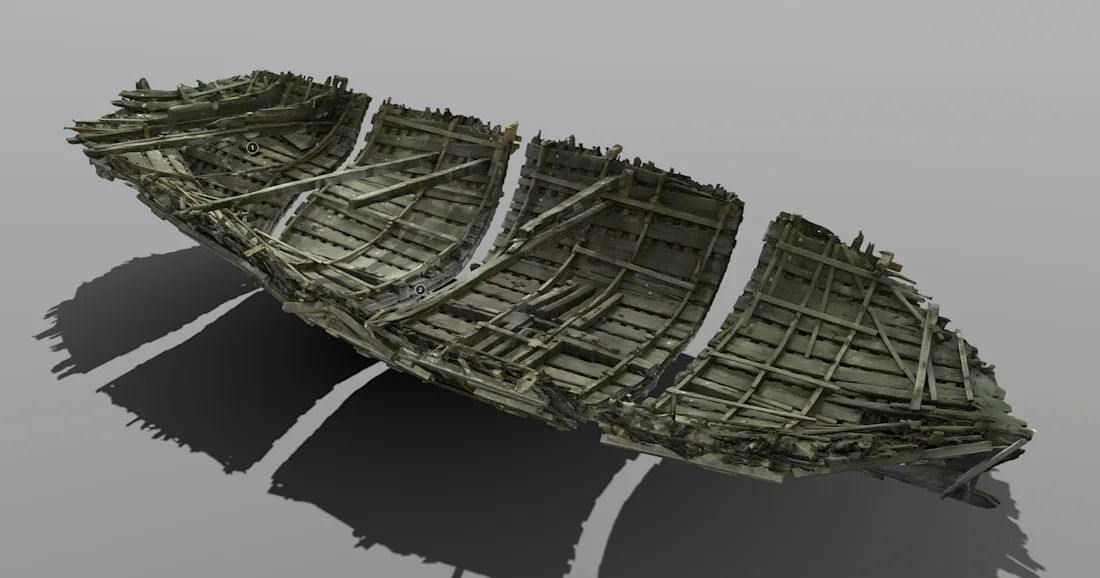
Twin it! 3D for Europe’s Culture – Part II invites Ministries of Culture of European Union Member States to collaborate with their national cultural institutions to submit at least one high-quality 3D-digitised heritage asset to the common European data space for cultural heritage, with clear reuse intent. Through the campaign, a collaboration between the Europeana Initiative and the European Commission, colleagues in Estonia have been working to submit the 3D model of the Lootsi wreck in 3D to the data space through Europeana.eu, supporting its reuse and research. They tell us about the wreck, the digitisation process and how the 3D model is being reused.
The Lootsi wreck - 3D scanning a uniquely-preserved shipwreck
The wreck of a well-preserved 14th-century merchant vessel was discovered in 2022 during construction works near the Old City Harbour in Tallinn, Estonia. After initial excavations on site, the ship was transported to the Estonian Maritime Museum in four sections and housed in a purpose-built building. Excavations continued there, revealing numerous artefacts hidden between the frames and planks. Simultaneously, the ship was documented and measured.
As part of the documentation, experts produced three 3D models of the wreck. They used laser scanning and photogrammetry to create high-resolution point clouds of the wreck and models of the loose ship elements recovered during the excavations. In these point clouds, every point created by measuring the object with a laser has its unique coordinates, which determine its location in the xyz coordinate system. Laser scanning creates thousands, sometimes even millions of such points located very close to each other. In addition to location, the color of the object is saved and for the human eye, a very dense point cloud seems like a model of a solid object. Three such models were produced in different seasons (spring, summer and autumn) to assess the deformations in the ship's hull.
Scanning the ship was a long and complicated process. The wreck has an internal wooden support structure and external metal supports that partially cover and obscure the ship’s constructional features. Therefore, the scanning process was more complex than usual, and numerous scans from different angles were required to create a point cloud with complete coverage. Since the point clouds captured everything in and around the wreck, an extensive cleaning process was necessary to prepare the point cloud for subsequent stages of work. Several models were created with different point densities and file sizes. The ship sections were modelled both together and separately, and finally, a relatively small textured mesh model was produced for initial reconstruction.
Enabling reuse of the wreck
Precise models of a large and complex structure such as a wreck can be used in many ways. The first is dissemination. The Estonian Maritime Museum is committed to making information about its collections accessible to the widest possible audience, and high-quality 3D models play a key role in this process, as they enable researchers and the general public to study the object in great detail and from every possible angle. The point clouds are also used in archaeological research, as they allow comparisons between the wreck and other similar finds across Europe. The three models additionally form a useful tool for conservators, as they are used to monitor deformations in the ship's hull.
A vital aspect of archaeological research is determining the vessel’s original shape and size. To answer these questions, 3D models are of great importance. Simple reconstructed elements (such as the vertical or raked timber in the bow known as the stempost) can be easily added, while the previously scanned and modelled loose details can be virtually returned to their original positions. This process makes it possible to determine the original location, and sometimes even the function, of these elements without damaging the real objects, and to test or refute various hypotheses about the ship’s construction.
Another important question that digital models can help to address concerns the ship’s seakeeping abilities. As an archaeological artefact, the wreck can no longer be tested under real conditions, so the necessary calculations must be carried out using virtual reconstructions. By analysing the models with the specific software, the ship’s displacement and cargo-carrying capacity can be determined, along with numerous other parameters. This provides a unique insight into the world of medieval seafaring.
The value of 3D models and the Twin it! campaign
3D models, together with other modern technical solutions, have enabled the Estonian Maritime Museum to present this unique perspective to diverse audiences. 3D models have played a key role in developing various exhibition solutions, including animations, virtual reality experiences, and 3D-printed hands-on exhibits for visually impaired visitors. In addition, digital models provide a valuable resource for the long-term documentation and preservation of the museum’s collections.
As the biggest medieval ship excavated in Estonia, the Lootsi wreck was a logical choice for publishing on Europeana.eu as a detailed 3D model through the Twin it! campaign. The model will enable the viewer to get a first hand look at one of the most remarkable archaeological finds in the Baltics and raise awareness and knowledge about our maritime past. Hopefully the model will inspire future researchers, museum specialists and game developers and generate new ideas about disseminating the cultural heritage.
Find out more
More information about the wreck can be found at the website of the Estonian Maritime Museum. The excavations and discovered artefacts are described in an article published in Archaeological Fieldwork of Estonia.
You can find out more about Twin it! on the data space website news section.